
Pricing tree service maintenance plans often seems straightforward at first glance. However, adding variables like crew time, equipment needs, and property size creates confusion. It is easy to miscalculate without a solid strategy.
Underpricing leads to a full calendar but an empty bank account. Overpricing causes your estimates to lose out to a tree trimmer who ignores their overhead. You need a reliable method to price your services to remain competitive.
This guide provides a framework for pricing tree service maintenance plans across various property sizes. You will learn to structure plans, account for tree location, and manage risk. This approach helps turn one-time jobs into steady recurring revenue.
Got questions? We have answers. Schedule a short call with TreeCareHQ here.
Table Of Contents:
- Why Maintenance Plans Drive Growth For A Tree Service
- Know Your Numbers Before You Price Anything
- Core Elements Of Pricing Tree Service Maintenance Plans
- Pricing Tree Service Maintenance Plans For Small, Medium, And Large Properties
- What To Include And Exclude In Your Maintenance Plans
- Factors That Inflate Maintenance Costs
- Building A Simple Maintenance Plan Pricing Calculator
- Sales Positioning And Risk Management
- Frequently Asked Questions
- Conclusion
Why Maintenance Plans Drive Growth For A Tree Service
Many tree services rely heavily on large removal service jobs or storm cleanup. While the revenue from a large tree removal is significant, it is also unpredictable. A mild storm season can drastically reduce your income.
Maintenance plans change this dynamic. They establish predictable revenue streams and allow for better scheduling. This model functions like a subscription for tree care.
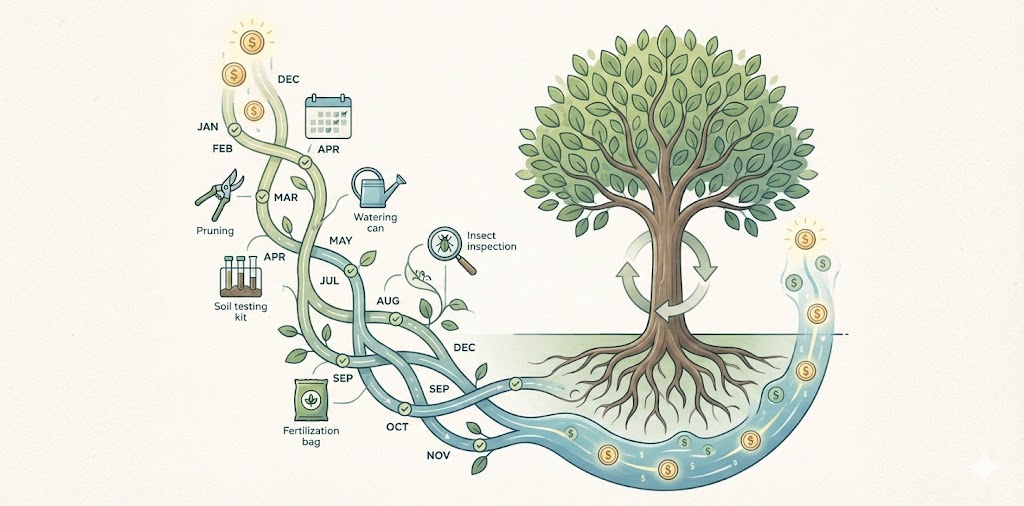
HVAC contractors adopted this model years ago. They sell checkups to prevent system failures. Similarly, companies benefit from maintenance plans by promoting efficiency and comfort. This same logic applies to managing tree health.
Clients pay a set monthly or annual fee for specific benefits. These plans typically include:
- Routine inspections by a professional tree expert.
- Scheduled tree pruning and crown cleaning.
- Debris removal and general property cleanup.
- Basic monitoring for pest control issues.
This structure stabilizes your cash flow. It also minimizes high-stress emergency work. Since contractors carry tree service insurance to mitigate risk, maintenance plans help control exposure. You catch problems early before they become costly claims.
Know Your Numbers Before You Price Anything
You cannot effectively price small trees or large estates without knowing your operational costs. Pricing without data is essentially guessing. You must establish a baseline.
Start with labor costs. The average hourly rate for tree trimming services varies, but you must account for more than just wages. Include payroll taxes, workers’ compensation, training, and downtime.
Labor often consumes 30 to 50 percent of operational funds. According to the 2024 Tree Care Business Cost Report, equipment upkeep alone is expensive. This excludes fuel, disposal fees, and administrative overhead.
Here is a method to calculate your hourly service cost.
| Cost category | Example monthly amount |
|---|---|
| Crew wages (2 workers) | 7,500 dollars |
| Taxes and benefits | 1,500 dollars |
| Equipment payments and repairs | 1,800 dollars |
| Fuel and disposal | 900 dollars |
| Insurance and licenses | 700 dollars |
| Office and admin | 1,000 dollars |
| Total monthly cost | 13,400 dollars |
Suppose a crew works 132 billable hours a month. Dividing your total cost by these hours gives a base cost of roughly 102 dollars per hour. This figure is your break-even point.
To be profitable, you must add a margin. A professional tree trimming company targeting a 20 percent profit needs to mark up that base rate. Strategic pricing can boost your margins significantly without increasing your workload.
Core Elements Of Pricing Tree Service Maintenance Plans
Once you understand your costs, build your pricing model. View each plan as a bundle of tree maintenance tasks. These tasks are tied to a schedule and specific risks.
Key factors to consider
- Tree size: Categorize by height and spread, not just lot acreage.
- Tree count: Note the number of fruit trees, hardwoods, or pines.
- Accessibility: Check for fences, slopes, or power lines.
- Risk: Identify trees near buildings or utility lines.
- Service frequency: Determine if visits are monthly or quarterly.
- Inclusions: Define if trimming focuses on aesthetics or safety.
Basing price solely on acreage is a mistake. A small yard with a massive oak is riskier than a large lot with only small ornamental trees. The risk profile dictates the price.
Make your plans easy for clients to comprehend. Companies charge more for complexity, but the customer needs to see the value. Clear tiers help sell the service effectively.
Pricing Tree Service Maintenance Plans For Small, Medium, And Large Properties
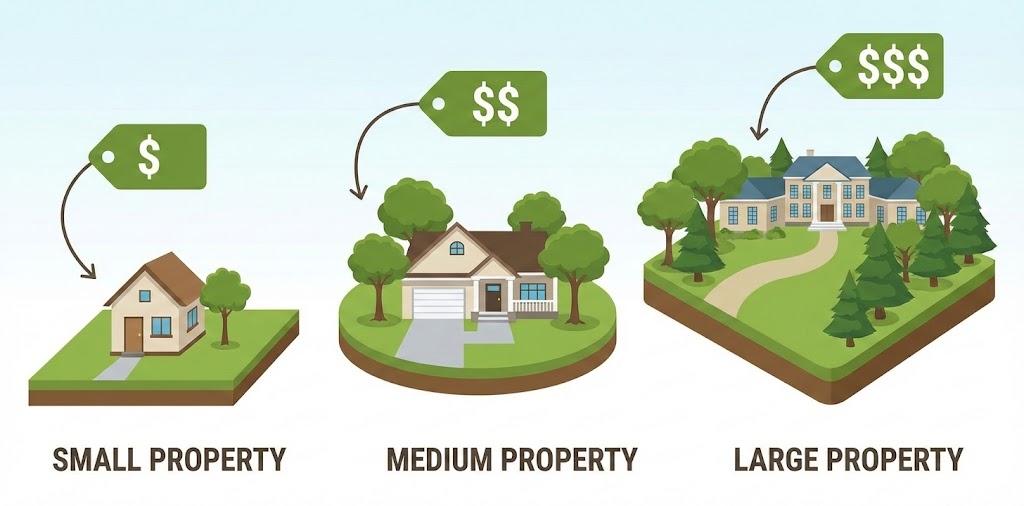
Use a tiered structure to address different property needs. Adjust these examples based on your local market and specific maintenance costs.
Small properties
These properties include townhomes or small suburban lots. The trees usually located here are manageable. Access is typically straightforward.
A typical scope for a small plan includes:
- 1 to 6 trees up to 30 feet tall.
- One annual inspection with a detailed report.
- One visit for tree cutting or light shaping.
- Removal of fallen branches and light debris.
Estimate your annual labor hours to set the price. If a visit takes three hours total, multiply that by your billable rate. A service tree plan like this might cost 400 dollars a year.
You can bill this as a monthly fee. Utilizing a tree service invoice template helps standardize these recurring charges. It keeps your billing professional and consistent.
Medium properties
Medium properties present more challenges. These sites often have diverse species and obstacles. They may require specialized equipment to reach difficult areas.
Scope for a medium plan often includes:
- 7 to 20 trees of mixed maturity.
- Two health inspections per year.
- One heavy pruning cycle and one touch-up.
- Hazard checks following severe weather.
- Care for bushes and small trees.
You might budget seven crew hours annually for this site. At a standard billable rate, this equals roughly 930 dollars a year. This breaks down to an affordable monthly rate for the client.
Be aware of add-ons. Pest control treatments can increase expenses. Since the average cost for removal is high, ensure major work is billed separately. You do not want to absorb expensive tree trimming cost variances in a flat rate.
Large properties and estates
Large estates involve significant liability. These clients often have high standards for curb appeal. They expect their tall trees to look pristine year-round.
These plans usually cover:
- Private estates with extensive canopies.
- Commercial campuses or HOA common grounds.
- Properties requiring work near local utility infrastructure.
- Homes with long driveways lined by trees.
Price these plans to cover frequent visits. You may need certified arborists to monitor for disease. Removing large deadwood over structures takes time and skill.
The time investment might reach 20 or 30 hours annually. If your rate is 160 dollars per hour for high-risk work, the annual fee could exceed 3,000 dollars. Structuring this as a quarterly retainer often works best for these clients.
What To Include And Exclude In Your Maintenance Plans
Clarity is vital when selling these plans. Vague terms lead to disputes over additional services. Be specific about what the trimming cost covers.
Typical inclusions
- Scheduled health checks on all yard tree specimens.
- Light trimming service for shape and structure.
- Cleanup of twigs and branches from pruning.
- Hedge maintenance within defined height limits.
- Minor mulch applications in bed areas.
Bush trimming and mulch installation have their own costs. Decide if you want to include these or charge extra. Trimming costs can spiral if you are not strict about limits.
What should be billed as extra
- Tree removal for trees over a certain diameter.
- Stump grinding and deep root removal.
- Emergency responses outside business hours.
- Work requiring coordination with a utility company.
- Chemical applications for trees infested with bugs.
Major tree removal jobs vary wildly in price. Trimming services for hazardous limbs also cost more. If you bundle these into a standard plan, you risk losing money on a single job.
Factors That Inflate Maintenance Costs
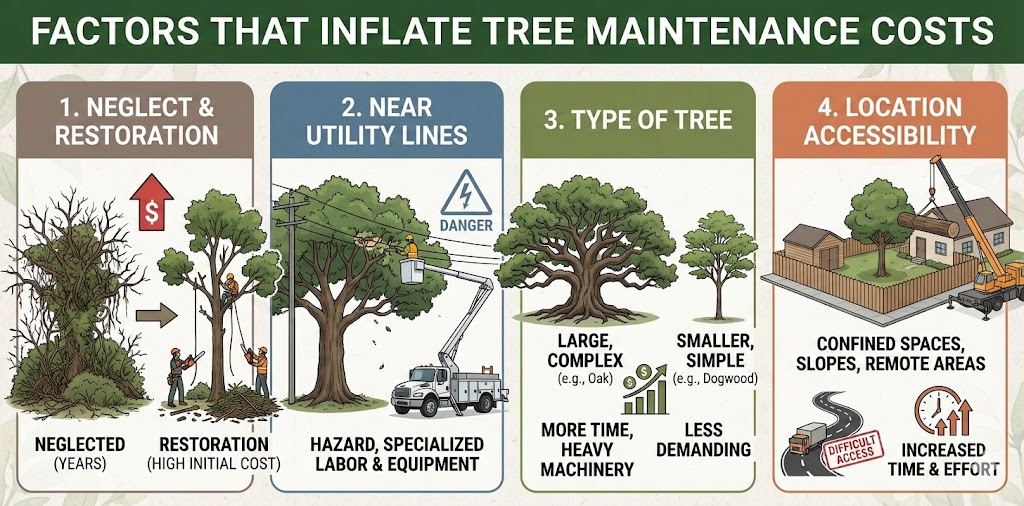
Several variables can drive up the price of a plan. Location accessibility is a major factor. If a remote area requires long travel times, your fuel and labor costs rise.
The type of tree also matters. Some species grow faster and need more frequent attention to prevent overgrowth. Fruit trees often require specific pruning techniques to produce well.
Work near utility lines is another cost driver. This dangerous work requires specialized training. Companies charge a premium for the risk involved in line-clearance operations.
Finally, trees that are neglected for years require initial restoration. Charge for a “catch-up” service before starting the standard maintenance rate. This brings the property to a manageable baseline.
Building A Simple Maintenance Plan Pricing Calculator
A complicated software suite is not necessary to start pricing tree service maintenance plans. A simple spreadsheet is effective. You can track variables like tree size and count.
Organize your columns as follows.
| Factor | Example options |
|---|---|
| Property type | Residential, estate, commercial, HOA |
| Tree count | 0-5, 6-15, 16-40, 41+ |
| Average height | Under 20 ft, 20-40 ft, over 40 ft |
| Access difficulty | Easy, moderate, difficult |
| Risk level | Low, medium, high |
| Visit frequency | Yearly, bi-yearly, quarterly |
Assign a crew-hour value to each level. A low-risk site with a few small trees might need 2.5 hours. A high-risk estate with larger trees could need 25 hours.
Multiply the total hours by your hourly rate to find the annual price. Divide by 12 for a monthly fee. Using a tree service invoice template ensures your estimates look professional every time.
This method gives your team a standard way to quote. It removes the guesswork from the sales process. Consistency is vital for long-term profitability.
Sales Positioning And Risk Management
How you present the plan is as important as the price. Explain that these plans prevent costly emergency work. Clients pay for peace of mind.
Highlight the value of inspections by certified arborists. They can identify weak limbs before they fall on a roof. Regular monitoring improves overall tree health and safety.
For business owners, cash flow management is crucial while building this revenue stream. Keeping personal and business finances separate is essential for any tree expert.
Ideally, your income will be a mix of big jobs and monthly fees. High-ticket removal service projects provide bonuses. The maintenance plans cover the bills.
Frequently Asked Questions
How much does a tree trimming service typically cost?
The tree trimming cost varies based on tree size and location. For a one-time job, prices often range between 250 and 500 dollars. Maintenance plans spread this cost out over the year.
Why do trees require regular maintenance?
Regular care prevents disease and structural failure. A regular tree inspection catches issues early. This protects a client’s property and extends the life of the tree.
Do trimming costs increase for tall trees?
Yes, tall trees require climbing gear or buckets. This adds time and risk to the job. Consequently, the trimming cost is higher than for ground-level work.
What counts as additional costs?
Items like stump grinding and hauling large logs are usually extra. A called tree service might also charge for travel to a remote area. Always state the exclusions in the contract.
Can you trim trees near power lines?
Only qualified line-clearance tree trimmers should work near high voltage. This is dangerous work. Ensure your crew members have the necessary qualifications and safety know-how to work on trees near utility lines.
Conclusion
Many contractors struggle because they guess at prices. They fail to account for the true cost of doing business. Pricing tree service maintenance plans with a clear formula solves this problem.
Understand your hourly costs first. Create clear tiers for properties that align with the required work. Use real data on pruning costs and labor to justify your rates.
As you refine your approach for pricing your maintenance plans, your business becomes more stable. Your calendar fills with predictable work. This allows you to build a resilient company that pays you what you are truly worth.
Ready to take your tree business to the next level? Schedule a short call with TreeCareHQ here.